Latest News

Latest News

DNA Repair Enzymes: To have an Fe-S cluster or not?

That is the question.  Research by the David lab provides answers into the roles for Fe-S clusters, a cofactor more commonly found in redox enzymes, in DNA repair enzymes. In an article in Nature Communications, structural and functional profiling of inherited cancer-associated variants (CAVs) near the [4Fe-4S] cluster cofactor of the human DNA repair enzyme MUTYH, revealed an allosteric network that connects DNA binding at the cofactor to damaged base removal at the active site.  Th

A new look at supercooled liquid water

Liquid water can be cooled below 0° C without freezing, a phenomenon known as supercooling.  However, below -50° C, the properties of supercooled water are difficult to measure due to rapid ice crystallization.  There is a long-standing question of whether there exist two distinct phases of liquid water under deeply supercooled conditions, called "high density liquid" and "low density liquid".

The first-ever synthesis of heterointercalated Chevrel-phase sulfides for renewable energy

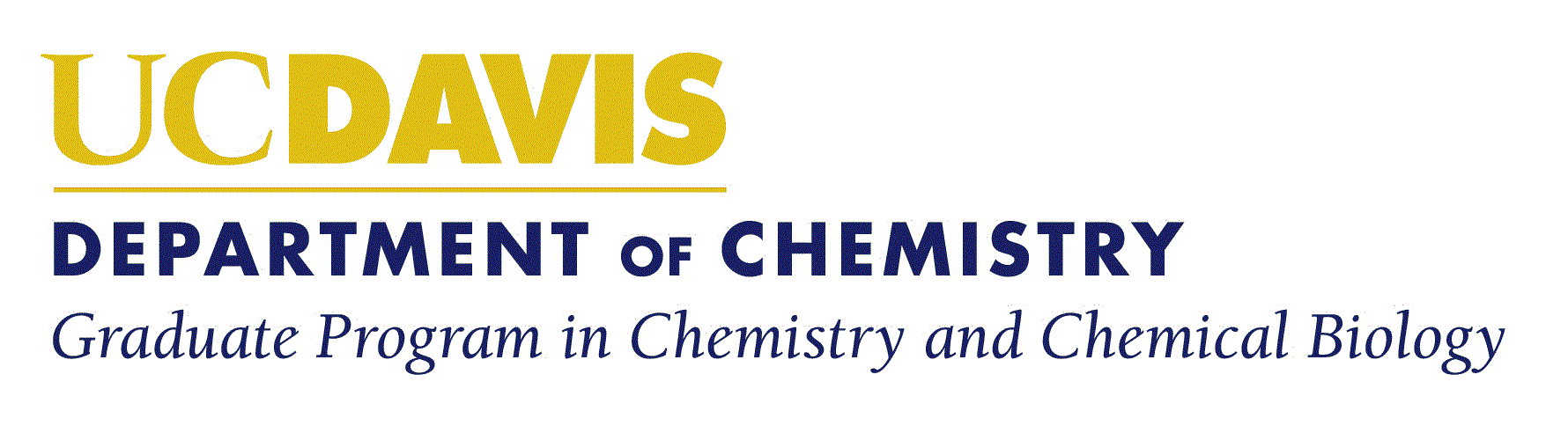
A recent publication from the Velázquez lab presents the synthesis of heterointercalant Chevrel phase sulfide compositions, which have been accessed for the first time through rapid microwave-assisted solid-state synthesis, for applications in energy conversion reactions. Through elemental spectroscopic analysis, a chain electron transfer mechanism was investigated and examined by electrochemically reducing CO₂ to elucidate the distribution of electron density and the subsequent binding affinities of CO₂ resulting from the identities of intercalants.

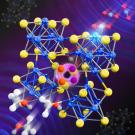
Professor R. David Britt presented his research at the 100th Birthday Memorial Symposium for Alfred R. Bader at Queen’s University in Ontario


Recently UC Davis Chemistry Professor R. David Britt was honored to represent the US ACS Bader Award winners at the 100th Birthday Memorial Symposium for Alfred R. Bader at his Chemistry alma mater of Queen’s University in Kingston Ontario.


The Queen’s University International Student Chapter of the American Chemical Society (Q-ACS) was excited to host the first-ever Bader Symposium on Monday, November 18th, 2024 at the Isabel Bader Centre for the Performing Arts to celebrate the 100th birthday of the late Dr. Alfred R. Bader this year.


 

New Solar Cell Shows Promise for Harnessing More Sunlight

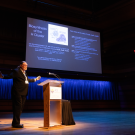
Moving society toward a greener future hinges on efficient technologies. Silicon solar cells, currently the leading commercial technology in the solar cell arena, reach energy conversion efficiencies of 18% to 22%, according to the U.S. Department of Energy. That means roughly four-fifths of the energy from the sunlight isn’t being harnessed by current commercial photovoltaic technology.

Mechanism of Psychedelic-Induced Neuroplasticity

In a recent publication in Science, the Olson Lab used chemical and molecular tools to elucidate the mechanism of psychedelic-induced neuroplasticity. They found that activation of intracellular 5-HT2A receptors was essential for psychedelics to promote cortical neuron growth. Unlike psychedelics, serotonin is too polar to passively diffuse across cell membranes, and thus, it does not produce the same effects on structural neuroplasticity.

Professor Sheila David Awarded the 2022 Education Award from the Environmental Mutagenesis and Genomics Society

Congratulations to Professor Sheila David (@sheiladavidUCD) for receiving the 2022 Education Award from the Environmental Mutagenesis and Genomics Society (@emgsus).  The EMGS aims to understand and mitigate the impacts of environmental exposures on the genome to protect human health, and strives to promote excellence, diversity and inclusiveness in research, professional development and collaboration. &

In Memoriam: UC Davis Collaborator Professor Makhlouf J. Haddadin

Professor Makhlouf J. Haddadin, American University of Beirut (AUB) – a two decades long collaborator of UC Davis Prof. Mark Kurth – passed away on 21-Sept-2022 in Amman, Jordan. He received a B.Sc. in 1957 from AUB and continued to get his MS degree at AUB working for Prof. Costas Issidorides (who was also a visiting lecturer at UC Davis). Makhluf did his Ph.D. in Organic Chemistry with Prof. Alfred Hassner at the University of Colorado, Boulder (1962) and then went to Harvard University for a two years Postdoctoral study with Prof. Louis Fieser. Dr.

Professor Annaliese Franz Appointed to Interim Associate Dean

Dean Estella Atekwana provided an exciting new update on the recent status of filling the Associate Dean for Academic Programs and Planning role in the College of Letters and Science. Dean Atekwana announced that Professor Annaliese Franz of the Department of Chemistry would step in as Interim Associate Dean effective July 1, 2022. 

New Theoretical Method Reveals Polarization Effects of Solvents Over Photoreactions

In a recent publication (Song, Journal of Chemical Physics, 2022) the Song Lab introduced state-averaged complete active space self consistent field (SA-CASSCF) coupled with polarizable continuum models (PCM), a new theoretical method that enables simulating polarization effects of solvents in non-adiabatic excited state dynamics for the first time.

Direct Conversion of Captured CO₂ into Fuel and Chemicals

A recent award from the University of California, Office of the President has established a new multi-campus Research Center focused on development of catalysts, methods and scaled-up prototypes for fundamental knowledge needed to convert captured CO₂ into fuels and commodity chemicals. The collaborative team is lead by UC Davis Chemistry Principal Investigator Prof.

2 + 2 = 3: Making Ternary Phases through a Binary Approach

New work from the Kauzlarich group in collaboration with NASA Jet Propulsion Laboratory looks to unveil the mysteries of solid-state reactions. The investigation into the formation of Yb₁₄MSb₁₁ (M = Al, Mn, Mg), a high efficiency thermoelectric material, from the elements and binaries revealed a pathway for the direct formation of high purity complex ternary phases in balanced stoichiometric reactions utilizing binary precursors.